Making Students Responsible
One of the main reasons that Napster has taken much of the various universities bandwidth has been the lack of education and responsibility of the students. SAUC feels that it is our responsibility to educate and inform students on MP3 issues, especially since various universities aren't going to take the time, nor the effort to make their students responsible for themselves, instead of holding companies like Napster responsible for the increase in network bandwidth and piracy.
What Is MP3 Technology?
With computers and Internet making appearance in this decade, sound technology took another leap. Storage of the sound and specifically, delivering sound over distances required considerable compression. With high high speed microprocessors became available at affordable costs, this technology got boost and now we have many standards for compression and providing streaming sound over the distances even with present limited bandwidth. Present standards which are suitable for this: Real Audio, Liquid Audio and now MP3. The latter give the largest compression.
The word MP3 as technical term stands for MPEG layer 3 It a type of audio codec where audio sound is processed by significant compression from the original audio source with very little loss in sound quality. To obtain compression without the loss in quality 128 or 112 Kbit/s is used which translates into giving 1 MB file for 1 min. of sound (which means that an average CD ROM can hold 10 hrs. of music or sound). It is claimed that low-rate MP3 files sound better than Real Audio files with similar bit rates. The advantage of MP3 is that it can be broken into pieces, and each piece is still playable. The feature that makes this possible (headerless file format) also means that MP3 files can be made to stream across the net real-time (assuming the playback bitrate and speed of the Internet connection are compatible).
Is MP3 Technology Legal?
MP3 is an audio compression file format and by itself is not illegal or legal, but like many technologies it can be implement for both legal and illegal uses. It is similar to zip compression common to most PC users. Zip files can be used to distribute copyrighted materials illegally or for legitimate purposes. Many people use MP3 to distribute unlicensed music, but many use the technology for completely legal applications.
What Are The Advantages Of MP3 Technology?
MP3 gives artists and labels freedom to market and sell their music anyway they wish. Artists and labels can employ MP3 technology in the best way to suit their individual needs. Give away one song to sell a CD, distribute low quality versions of songs, sell individual songs for digital delivery, prepared an audio commercial to songs, there are limitless possibilities for artists to explore.
MP3 is the standard for high quality music and will soon be on every PC. MP3 is an open standard, meaning no one organization controls it. On the Internet, open standards win and this is why even without any significant corporate backing, MP3 is already the de facto standard.There are more MP3 listeners, software programs, and hardware devices than any other CD quality audio format in the world. Microsoft has built MP3 support into Windows98 SP1. Macromedia Shockwave uses MP3. Newest version of RealPlayer will support MP3. Microsoft NetShow also supports MP3.
Use MP3 Responsibly
Using the MP3 file format responsibly is the only way a user can help maintain the integrity of the file format/ digital music revolution. Adhere to all copyright laws. If you, as an MP3 user, are in doubt of the legality of an MP3, please contact the Recording Industry Association of America. Although SAUC feels that the current copyright laws are a bit to stringent, we don't advocate copyright violation in any way. SAUC is designed to lobby on behalf of free thinkers and change policy, not break it.
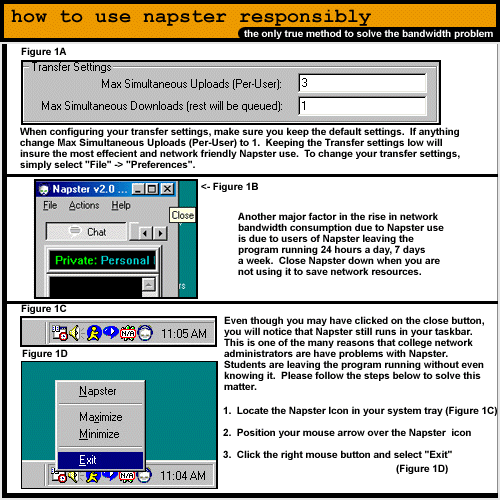
There have also been many bandwidth concerns throughout many college campuses. SAUC would like to take this opportunity to educate students on how to properly configure and use Napster in order to keep Napster on your campus.